Thursday, 22 August 2013

2013 - June: Crossing Amorgos


We chose the island of Amorgos in the 'Small Cyclades' as it sounded very middle-aged: no clubs, no posh bits, no big sites, in fact not much at all.   But this also meant poor transport links, so we had to do 5 hours on a fast catamaran from Piraeus. Fortunately the sea was pond-calm, so we were neither late nor violently sick.

Amorgos - in the middle of nowhere, and just as difficult to get to
Amorgos does have some good walks and some even had markers, and the major 'Route 1' is from the Chozoviótissa Monastery to Eghiali Bay, where we were staying.  


Our walk (the black arrows are not marked on the island)

It was a wonderful hot day so we stocked up with drinks. hats and suntan lotion, and got the morning bus down to the start at the car park below the Monastery.  Then a long set of steps up to the stark white edifice stuck onto an almost-sheer rock face - about 7 stories high and one thin room deep.  Nearly 1000 years old, and said to have influenced Le Corbusier.

The trudge up to the monastery
They were doing the Forth-Bridge performance of painting the wall (white).  The painter's platform was suspended by a rope controlled from down below by his mate who simply wound the rope round an iron stake sticking out of a wall.  


 This is my first and only Health and Safety video.

The chapel - you can just see the knees of a real live sleeping monk
There are only 3 monks left out of the 30 or so who used to be here - climbing those steps all dressed in black must have not done them any good.


We got shown into a little dining room, and got given the customary glass of water, loukoúmi (like Turkish delight) and a rather welcome shot of the local firewater, flavoured with honey and spices. 


Winner of the All-Greece 'Best Hair and Hat' competition of1923 

The monks' view - the nude bathing beach is just out of view to the right

Off in the heat up the island
While other visitors went back down to the car park, our path continued up past the monastery and off into the very bare east side of the island.  In fact the west side is bare too - there is one road that goes to the north, and we were following the old donkey path. 

Dry, hot and rocky.
The walking was not particularly tricky, although the path sometimes comprised of largish stones and the risk was in twisting an ankle, particularly as we were both just wearing sandals.  Worth the risk though - boots and socks would have been very uncomfortable and with frequent stops for drinks we did not get too hot.  We sat and had a picnic at the abandoned village of Asfondilitis which was just over half-way.  Then we came over the ridge and started the long descent into Eghiali, where we could see our apartment across the bay.

The last part of the walk goes along the top of this ridge- view from our apartment
It was a relief to get back to our wonderful cool apartment, and throw ourselves into the extraordinarily clear sea.  Then up to our local taverna to see what they had stewing in the kitchen - squid and spinach was my favourite, with cold white wine.  Perfect, and well-deserved.
View of Eghiali from Levrossos where we were staying
This and other walks in Greece are covered in this brilliant website , who said this was a 4-hour actual walking time.  Which was fairly accurate, but our total walking time was more like 6 hours.

Amorgos was a great island - basic, very friendly, and perfect for a real holiday.  We would strongly recommend our Levrossos apartments, which were exactly as they appeared in the advert.


Monday, 22 July 2013

2013 - June: A hot walk across Dartmoor


It seemed a good idea to walk from the North to the South of Dartmoor on two of the hottest days of the year.  I took the bus from Barnstaple to Okehampton, backpack heavy with energy drinks and melting chocolate.  The route below revisited some of the parts of the moor I trekked over when I was 15 and doing the Ten Tors expedition - amazing that we did 50 miles in a weekend in rough conditions, with heavy kit and no mobile phones.  Kids nowadays...blah blah...

Rough map of trip - not in straight lines
The first challenge was going up Yes Tor, just about the highest point on Dartmoor.  I quickly realised that the long spell of dry weather meant the fearsome bogs were not a serious problem - they had dried up.  And navigation would be easy - no sudden dense mists - so target Tors could be identified miles away. Still I did use the compass, and only turned the phone on to text my progress and take pictures at a few high places (where there was, reassuringly, a signal).

View north from Yes Tor - having just climbed from that valley in baking heat and swigging Lucozade.
So to be honest the walking was rather easy - I even met someone taking their toy remote-controlled car for an outing on the top of High Willhays.  But still a bit of a slog, getting to grim Hangingstone Hill after about 3.5 hours walking, some on rough tracks. 
Slightly gloomy outlook south from Hangingstone Hill -  a notoriously gloomy place
The route south was around 5 miles of completely trackless moor, which would have needed some neat navigation if I were not able to see Rough Tor clear as anything on the horizon.  Still I had to cross the source of the Teign, the East Dart, and the West Dart rivers.  It was stinking hot, nobody visible for miles, no mobile signal, hoping I would not twist my ankle on the dry but tuffety bog.  The East Dart looked a bit red, but very tempting so kit off and in I was, with only a pony to watch.  Very cooling.

The East Dart river.  No picture of me sitting in it.

The bog leading up to Rough Tor was quite rough - if it had not been dry it would be have been very draining.  Rough Tor is right on the border of the Merrivale Firing Area, and the red flag was flying, so kept my head down.

Trying not to be shot at

Panorama from Rough Tor. Not a soul in sight.

Cottony stuff on tuffety stuff
Wistman's wood is supposed to the last remaining bit of the proper 'Dartmoor Forest' - knarled old oaks growing out from between lumps of granite covered in moss.  Feels like a set from a Tolkein film.  Tricky to walk over, and the first people seen for about 5 hours.

Watch out for goblins in Wistman's Wood
Then a very welcome pint of shandy in the smart hotel at Two Bridges, that nevertheless had a sign saying 'Muddy Boots Welcome' - felt very welcome, even though not muddy.  But tired. Then final walk along road to Princetown - a famously grim dump that looked rather fine in the evening sunshine.  And even finer when I got to my comfortable single room booked in the Plume of Feathers pub.  Nothing better than feeling utterly entitled to sit most of the evening in the bar, eating good food and drinking cold white wine.

It was another hot morning as I explored the joys of Princetown, including the wonderful abandoned railway line, the church built by Napoleonic prisoners-of-war, and the fine Prison museum.  The Prison managed to look dour and depressing, even in bright sunshine.

Small headstones for prisoners - no names, just initials.

Luckily I did not sleep here
Set off south, staggering under the weight of all the Lucozade sport that was going to keep me hydrated on a stinking hot day. Walked through old tin mines, ground all chewed up like a World War 1 battlefield, occasional deep shafts with a fence round them.   Then there was about 5 miles without any sort of track, and so took a compass bearing and set off in a straight line across Foxtor Mires.  Turns out this was Conan-Doyle's inspiration for Grimpen Mire in Hound of the Baskervilles, and if it had not been abnormally dry it would have been a very stupid route.  But it was like walking on a mattress - fortunately did not break through the crust and so all well.
Fine granite wall in the middle of the bog
Trudged on, using occasional standing stones to check the bearings, and even saw another walker, who I greeted merrily.  He took no notice whatever, so I hoped he would fall down a mineshaft.  Got to the source of the River Erme, and once again it was kit off an into the cool, rather reddish water.  Heaven.
My bathing place in the River Erme
Walked through the old settlements in the valley, and then took a wrong turning and got hot and bothered clambering up a hill trying to find the route of the Two Moors Way.  Eventually stumbled on a fine path, dead level disappearing over the moor in both directions.  Turns out this bit of the Two Moors Way runs on the track of the old tramway that ran from near Ivybridge to the Red Lake China Clay works: good photos here and here's some history.

The 'Puffing Billy' track runs high across the remote Dartmoor
It was a relief to have some easy fast walking along the track, with walking stick clicking on the gravel in a satisfactory way, and views to Plymouth and miles to the edge of the poor.  Must have been ghastly and desolate to work here throughout the year.  So plodded happily into Ivybridge without a trace of heatstroke, to find my local train had been cancelled.  Just getting grumpy when in pulled the London express on an unscheduled stop, which was the very train I was supposed to be connecting with.  So hopped on, scarcely believing my luck.

In conclusion, a bit of an adventure and all went as planned, but I have to admit I was quite lucky - if the weather had been normal, the bogs would have made it much harder.  My navigation was OK, with a good map and some compass work, and I did not use the phone to find my position, so I think I would have managed even if the mist had come in.  Took a risk being on my own, as if I had twisted my ankle it would have been tricky and I even forgot my whistle, so would have had to stagger to somewhere with phone reception.  But I texted my position every couple of hours.  

A good walk.

Saturday, 26 January 2013

2012 - December. Burma: All ways of travel


By Plane from Rangoon


Internal flights in Burma have not a got a great reputation, especially after the crash near Inle Lake on Christmas Day, and the anxiety starts early.  When we reached the Domestic terminal, we got given a little coloured sticker to wear that indicated our flight.  We soon discovered why – there was no departure board, and only hugely distorted announcements which could have been in Burmese or English or Aramaic for all we knew. 


We then realized that when a flight was due to go, a man came round the room with a little sign, shouting out the flight number and destination. The passengers with the right stickers then traipsed after him onto the tarmac like the Pied Piper, leaving behind anyone foolish enough to go to the Gents at the wrong time. So we held it in and waited.  But the time for our flight came and went and anxiety started building, so we started looking round for people with our sticker, exchanging encouraging comments, and ganging up.  


Don't get left behind!

Our fortitude was rewarded when our rep came bellowing out, and we all trooped out feeling like we were taking the last flight our of Saigon, under the envious gaze of the other travellers left crammed in the terminal,. Some are probably still there waiting. 


By Pony round Bagan


Hot, dusty, very peaceful.  Being shown round a small monastery, with caves where the monks slept on bare beds.


Peace and heat in Bagan

By Boat up the Irrawaddy


We had cycled down to Old Bagan to catch some final temples, had got distracted by a lacquer works and needed to get back to our hotel.  I was not looking forward to the ride back in the baking mad-dogs-and-englishmen midday heat, and also regretting not having left time for a boat trip on the river, and Kate had the brilliant idea of combining the two.  So we went down to the jetty and haggled with a man who said he could take us and our bikes up river to Nyuang U near our hotel.  We had expected a shabby little tub, but instead got ushered through the refuse and mud to a very large, although still shabby, tub where we sat in splendour with our bikes, I and the Memsah’b.  

Our personal craft

The Irrawaddy here is huge and full of sandbanks and so it clearly took skill for the small boy to navigate upstream.  Very peaceful, that is apart from the deafening noise from the engine on a pole, the whole engine being moved as he steered.  This was where the British Indian Army crossed in February 1945 when re-capturing Burma, finding themselves confronting the Indian National Army who were fighting with the Japanese.  Then at Nyaung U we dumped our bikes over the side and pedaled back to our hotel, feeling rather pleased with ourselves.   And also feeling that 30 minutes on the Irrawaddy was enough for a while.


Up the Irrawaddy without a paddle


By Truck up to Golden Rock


The Golden Rock at Kyaitko is a major Theravadan Buddhist pilgrimage centre and 3 visits in a lifetime earns a lot of merit.  The rock is at the top of a very steep hill, with a single winding road. A constant stream of trucks roar up this hill at great speed, each with around 40 pilgrims sitting in rows on padded benches with no protection against rain or sun.  It’s very smoothly organised – the trucks line up in the shade in Kinpun at the bottom of he hill, with stepladders along the side, and after each fills up it starts off.  


A rock, that's golden


The day we went up was the one day of the year when the trip is free, and it took about 20 minutes, hanging on as we hurtled round hairpins - fortunately they operate a one-way system.  Great fun, lots of laughing and cheering at particularly exciting bits.  


The Golden Rock turned out to be impressive, but the pilgrim Disneyland around it was even more extraordinary – lit up like a fairground, full of festive pilgrims.  We were staying around 20 minutes walk down the steep hill, and our hotel was popular  with rich Thai pilgrims as each walk up the hill counted as a separate visit, and so all three could be achieved in a weekend. Palanquins were available for hire, which provide good employment but would have been seriously embarrassing.  Many westerners were using them, possibly as part of a package trip, but some clearly felt like we did and even when it was provided just got their bags taken up.


Embarrassing way to travel. For some.

By Pick-up to Hpa-an


Hpa-An was around 60 miles from Kinpun, but we got pointed to a pick-up.  This was an old Nissan, which must have been clapped out when it left Japan but was still going sort-of strong.  These pick-ups carry crowds of people and massive loads on the roof, often with more people top of the load.  Having already travelled in some crammed pick-ups, we did not fancy 3 hours of this and so paid extra (7,000 Kyat, £5) for a front seat next to the driver, which was hot and possibly more dangerous.  The pick-up was right-hand-drive as nearly all vehicles are in Burma – which is unfortunate as they also drive on the right.   So I could see all the traffic coming towards us as we did our over-taking. I tried to attain a higher mental state.


Kate sat in the middle, and the immaculately polite driver was so conscious of her presence that he refused to use 2nd gear as it would have needed her to move her backside, and so we always went from 1st straight to 3rd.   We tore along, horn blasting to pick up customers, and then diverted to a rice works where we filled the roof with sacks until the suspension hit the ground.  Shouldn't there be some sort of Society for the Prevention of Cruelty of Vehicles? Then we stopped again and filled half the back with large barrels full of water and live fish, so that the whole vehicle developed a strange rolling motion and an almost complete inability to stop.  But we got to Hpa-An, dropped outside the legendary Soe Brothers Guest House, and went to our double room with bathroom ($16).


By Hollowed-out log near Hpa-An

First hollow out your log

We entered a large cavern full of shrines, and then put our shoes back on to continue in pitch-black through a cave system in the limestone.  We came out into daylight above a calm lake, with views over the paddy fields to the mountains.  Our driver negotiated with the locals standing next to their log-canoes, and with some careful balancing we set off over the lake, where they also were trying to catch fish with drop-nets as in Cochin.  A short trip, then in under the cliff, quiet paddling in the dark until we came out into another lake, fishing nets, paddy fields.  The locals were continually talking and laughing with themselves and our driver, giving a wonderfully peaceful and good-natured feeling to the whole setting.  Magical.

The most peaceful place


By Boat from Hpa-An

Scenery near Hpa-an, on the Salween

The famous old government ferry from Hpa-An to Mawlamyine (Moulmein) does not run any more, but the guest-house owners have set up their own service for the few tourists.  It eventually set off, a narrow boat just sitting 5 of us in single file under the shade as we shot along feeling warm and relaxed and privileged.  But also excited by the trip and the scenery – limestone outcrops inevitably topped by a pagoda, villages right by the river with kids who shouted and waved, and a dead body floating along which did not seem to arouse any particular interest in the driver.  Someone has put a video of the trip up here  


Heading for the 'old Moulmein pagoda'

Sunday, 30 December 2012

2012 - December. Burma: a train journey


"Railway equipment is decrepit; fatal rail crashes occur, although they may not always be reported." 

(Foreign and Commonwealth Office website description of Burma Railways)


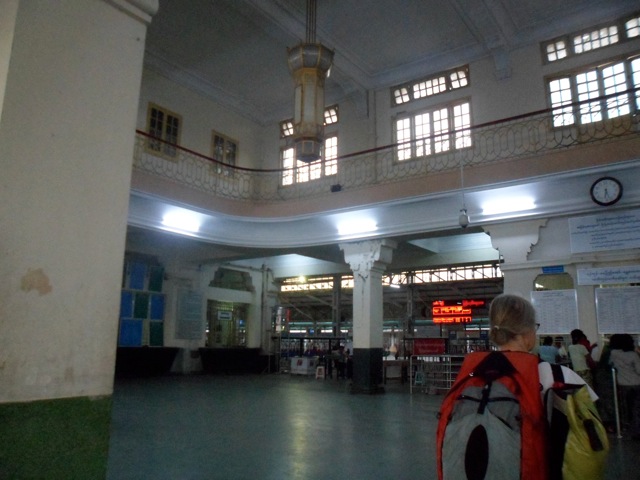
We arrived at Rangoon’s (Yangon’s) fine railway station at 6.15am without a ticket, but followed the blue signs saying ‘Warmly welcome and take care of tourists’ in Burmese and English: exhortations that have largely replaced the traditional patriotic slogans.  


A very friendly man obeyed the instructions and took us into his shambolic office and laboriously wrote us out a ticket, this being the land of chits and ledgers.  We paid in brand new US dollars, reluctantly supporting a government enterprise.  


Our return ticket: Mawlamyine to Yangon


The platform was full of traders with baskets of bananas and watermelons or rows of cheap watches.  A goat wandered around, trying to snatch bits of produce, and a few families were waking up after a night on the platform.  We found our allocated ‘Upper Class’ carriage, with reclining aircraft-style seats.  In fact they were ‘reclined seats’, as the mechanism had collapsed years previously.  The carriages were utterly shabby but the seats were covered and comfortable, especially as the whole journey was spent almost lying down.


With a fanfare of whistles, horns and much flag waving we set off on time at 7.15, at around 20 mph, with initially a fairly gentle rocking.  As the state of the line declined, then the rocking got worse requiring a steady grip on the armrest.   Then, like an ocean liner in a storm, a different form of motion started, this time violently up-and-down so that we almost left our seats.  I had never thought that seat-belts might be necessary in a train.  We talked later to a hardier traveller who was in hard class, and he said that when the vertical turbulence started everyone just stood up as it hurt so much landing on the wooden seats.

At our gentle pace, and large glass-less windows, we had a fine view of rural Burma continuing as it has done for centuries: planting out rice in the paddy fields, buffalo wallowing in the mud, children playing by the track.   Meanwhile women selling food continued to walk up and down the train with their trays on their heads, perfectly timing their movements as the carriages lurched in opposite directions, threatening to send them out through the wide-open doors.  Some of them had half a kitchen on their heads, and with all the pots and pans to produce a whole meal on a banana leaf, but we stuck to the wonderful corncobs.  We threw the remnants out of the window, while the locals threw everything out including plastic bottles, adding to the ubiquitous litter that only we westerners seem to notice.

Bits are missing
Things seemed to be going rather well and the tales of delays and disaster seemed exaggerated, but then suddenly there was a huge crash right below our seats.  I genuinely thought we had derailed, but we cruised to a gentle stop: this took some time as when everyone piled out to take a look it was clear that the whole brake mechanism from our carriage had fallen off.  

Putting the bits back
We all stood around watching a single individual tie up some dangling bits with wire, while a passing motorcyclist was roped in to go back and pick up a few large bits of stuff from the track, which were thrown into our carriage outside the (indescribable) toilet.   Then everyone piled back in and off we went, arriving at Kyaitko only an hour late: we crammed into a pickup with other pilgrims, then at Kinpun transferred to an open truck which took 40 of us to the top of the mountain of the Golden Rock.

6 hours for around 110 miles is not something that First Capital Connect would be proud of, but any faster would (a) have been unsafe because of the terrible state of track and rolling stock, (b) not have allowed the extraordinary view of the beautiful countryside and people.

* I will call the country Burma rather than Myanmar as (a) it’s the name given to it by the Foreign and Commonwealth Office, and so I assume it is the English name for the country (and I don’t refer to Germany as Deutschland) (b) Aung San Suu Kyi calls it Burma.